Let’s try something new for this blog – a short radical behaviorist leftist analysis of the recent chess based series The Queens Gambit. I will just highlight and comment on some aspects of the series of interest, without digging too deep for this first time.
As is customary online, here’s a warning that there are SPOILERS ahead!
Background or socio-economic status
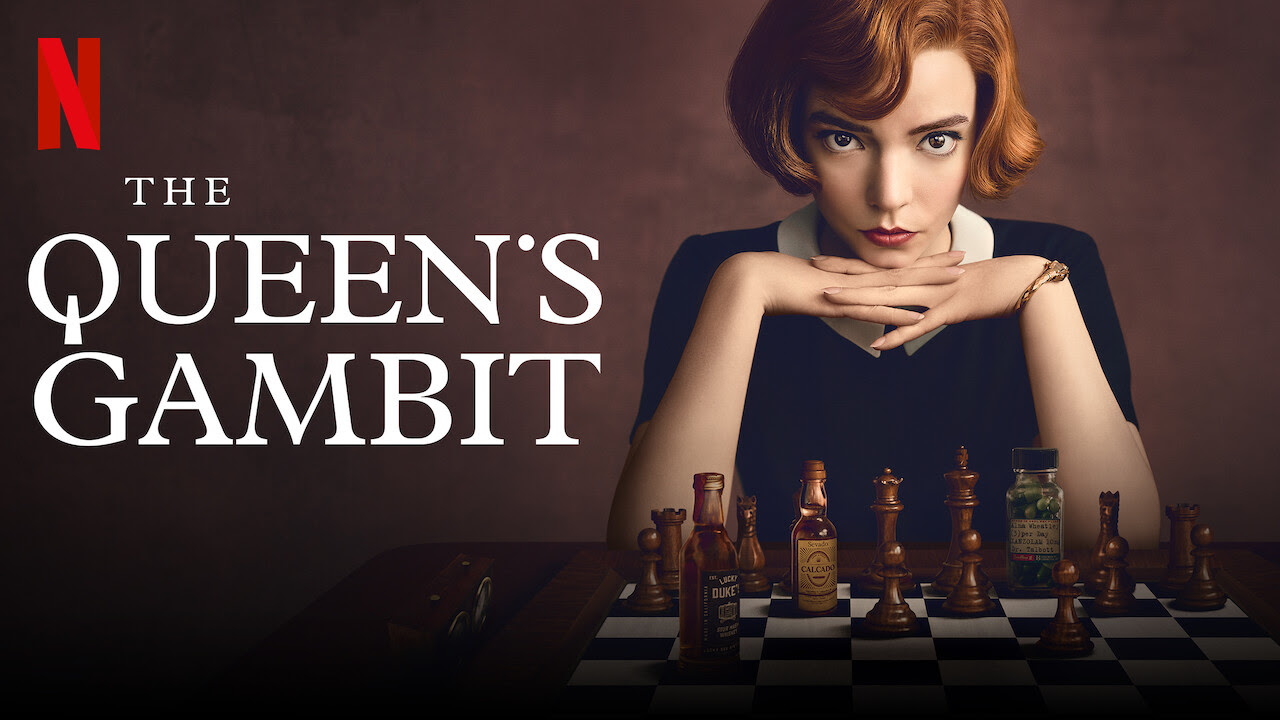
The series is based in the US and is a story about Beth Harmon – a chess prodigy and a woman chess world champion, dominating over the chessboard while at the same time grappling with various substance abuse problems.
One of the main themes of the series is the protagonist’s upbringing. After her mother’s death in a suicidal car crash, which Beth survived, she went on to live in an orphanage. Her mother and father were divorced and, as is revealed in the last episode, even though “her mother came from money and married into more of it”, Beth did not reside in a wealthy neighbourhood as she and her mother lived in a trailer. Afterwards, already in her teenage years, Beth was adopted. This already is quite unlikely, because, unfortunately, most adoptions happen up to the age of 5. Speaking about adoptions and troubled mothers, further points are provided by Jody Allen Crowe in his fine book “The Fatal Link” (2008). Though the book focuses on fetal alcohol syndrome (FAS), the common denominator here is a problematic maternal context:
Adopted children, unfortunately, are at a very high risk of having been prenatally exposed to alcohol. American families, to avoid adopting a “crack baby” from the United States, many times have adopted undetected brain damaged FASD children from Romania, Bulgaria, and other middle European countries. The unsuspecting adoptive parents are then overwhelmed with the litany of problems as a result of the biological mother’s drinking that led to brain damage. Simply put, who are the mothers who abandon their babies or put their babies up for adoption? The vast majority are young mothers who don’t want or can’t take care of their babies. These unborn children are at great risk of being the victims of binge drinking by the young mothers.
Jody Allen Crowe (2008) – The Fatal Link
The main point here is that Beth has quite a challenging background which makes the wonder story of the series in the real world quite unlikely. We’ll see why in a moment.
Talent or hard work?
One strand in any “skill-based” wonder stories like in the Queen’s Gambit, will always be the explanation of the new found success. What led to high level of chess play – was it Beth Harmon’s innate talent? Was it hard work? Or was it luck? Or maybe the drugs?
In reality, we have to mind the fact that most chess Grandmasters or even somewhat weaker players start playing chess from an (sometimes extremely) early age and they probably come from at least somewhat affluent families/background where the children have adequate resources, access to chess clubs and connections. Also, excelling at chess (as in any sport) takes an extremely long time and time in childhood is generally easier found – no trivialities such as making food, providing for the family, planning for tournaments, booking/flights or hotels bother the upcoming prodigy. They are taken care by the parents while the child can focus solely on the chess.
Now, in Queen’s Gambit we have an unrealistic story in this respect – coming from somewhat non-optimal familial context chances of sport success are slim. The loss of parents makes the chances even slimmer. With Beth’s ban of playing chess in the orphanage for a few childhood years, grandmaster success becomes practically impossible. Without proper financial support, a person in Beth’s situation would have to work and even with a chess hobby grandmaster heights would be out of reach.
So this “underdog”, “from rags to riches”, “pull yourself by the bootstraps” story, even though glorified in the capitalist, individualized society, has only a miniscule probability of happening. Perhaps, we can name some genuine success stories coming from disadvantage (certainly not Elon Musk or Jeff Bezos). Even so, mind the survivorship bias – if we focus on the percentage of people from similar contexts that have become successful (rich, famous etc.) and compare this to the overwhelming majority of non-success, we’ll come to a grim conclusion.
Feminism
One more, perhaps an inspiring to some, strand of the series is the gender of the protagonist. We have to mind that in the most part, chess is a very male-dominated activity. A woman chess champion never happened in real life while the series comes to this conclusion.
Beth Harmon casually the quite quiet girl, with a (traditionally speaking) deep and scarred inner life, seemingly not interested in mundane things (remember the girl tea party) and focused on one thing – chess. In the meantime, absolutely unrelenting over the chessboard with an aggressive attacking style and assertive in her relations, including sexual, with men in her life.
Even though breaking gender stereotypes, Beth is the best in regards of chess, still the typical gender roles are reflected neatly in the series. Speaking of chess, only the first opponent that Beth faces is a girl, all people related to the 64 squares from there on out are men – her opponents and seconds. Women participate in Beth’s life from traditional emotional contexts – most saliently her adoption mother with whom she develops a deep connection and also her “guardian angel” and childhood friend Jolene.
All in all, Beth may serve as a role model for girls/women who undertake activities mostly occupied by men – an inspiration to resist trivial temptations and work hard. Either way I would like to proceed with caution – “improving oneself” or “focusing on yourself”, i.e. individualized fighting with institutionalized inequalities for women might be as effective as banging a wall with one’s head. There is an argument to be made that economic inequality is based on gender inequality – arguably most labor in our societies is unpaid – domestic labor such as cooking, cleaning, taking care of relatives/nursing is mostly done by women and is not compensated. A fitting joke:
Economists sometimes joke that if a man marries his housekeeper, the GDP of the country declines.
Katrine Marçal (2015) – Who Cooked Adam Smith’s Dinner (p. 52)
Let’s not wander from our leftist leanings – not addressing systemic problems as is not done in the series, will probably lead us nowhere.
Drugs
Perhaps the most visible and shocking aspect of the series are the substance abuse problems of Beth. These issues find parallels in the chess world. In the 20th century, alcohol problems were common among chess players, e.g. Tal or Alekhine. An interesting and rare recent-ish example is of Vladislav Tkachiev and his passing out in one 2009 chess tournament.
Due to rising competition, now most grandmasters probably have a stricter lifestyle regarding substance abuse. Articles such as “What chess grandmasters eat for peak concentration and performance” and “The grandmaster diet: How to lose weight while barely moving” illustrate this neatly. Of course, we have to note that we are mostly speaking about a small number of top GMs, which have enough income for a more lavish lifestyle. Most people and even GMs can’t make enough money from simply playing chess and either have to teach chess or resort to other sources of income. We should also be aware that wealthier people have better nutrition, do sports and have an optimal body weight more often and generally live longer. As another joke goes (with credit and additional comment below):
The more random people people you see jogging for no reason, the higher the rent is going up.

Returning to 1. d4 d5 2. c4, what about Beth Harmon and her tranquilizer and alcohol issues (or should we say blessings)? By the way, the tranquilizer is a non-existing drug Xanzolam which resembles real-life Librium. In the show, Beth is actually helped by the drug as it contributes to her incredible focus and play. Furthermore, given the 60s context, alcohol abuse for a top-level player is a very realistic attribute. Maybe the drug was the critical puzzle piece of the series and the component needed for Beth Harmon’s success in an otherwise disadvantaged complex of conditions as discussed earlier. Nevertheless, in no way can this be recommended to try at home. Or perhaps, the substance abuse serves as an obstacle for the prodigy to overcome as otherwise it would be too easy a story – maybe even too unrealistic?
West vs. East
This aspect in the series has perhaps only a secondary significance. The players from Soviet Russia are portrayed as the juggernaut of chess that are generally much stronger than counterparts in the US. This is obviously inspired by 20th century reality of chess. The eastern lands are not necessarily presented negatively – Russia is shown to be a favourable place for chess players. The main lesson to be learned from the Russians is that their GMs help one another in the series while Americans tend to be more hostile to each other. This moral of collective strength may appear as ironic or paradoxical – on the one hand self-sufficiency of Beth is promoted while on the other the importance of camaraderie is demonstrated.
Conclusion
In conclusion, the short series The Queen’s Gambit is a quality watch, with eye-pleasing 60s aesthetics, drama, relationships and well thought-through chess with the help of Garry Kasparov. Just don’t expect much of critical behavioural or leftist analysis in the series and do go watch the series if you have not already.
 Radical behaviorist leftist